


23 February 2023
Germany added a new route for warnings
Germany’s civil-protection agency, BBK, put Cell Broadcast into operational use on 23 February 2023 after a trial phase. The system sends warning messages through mobile networks to compatible devices, adding another channel alongside sirens, broadcast media and warning apps.
It was a concrete change to the warning system, rather than another reconstruction promise. It also had limits: an additional delivery channel is not proof that every person will receive a warning or that authorities will always issue it in time. Repairing communication and making decisions during a crisis are related tasks, but they are not interchangeable.
12 December 2025
The Ahr Valley regained a through rail connection
On 12 December 2025, Deutsche Bahn announced the return of through passenger services between Remagen and Ahrbrück from 14 December. It reported rebuilding tracks, bridges, tunnels and stations along the flood-damaged route.
The regional tourism organisation subsequently confirmed that the railway was operating again by the end of 2025. That makes this more than an opening-day plan. For residents and visitors, a broken link had been restored. It did not mean that all homes, roads or river defences across the affected region had been repaired.
Deutsche Bahn · Ahr railway reopening announcement · 12 December 2025 · Ahrtal Tourism · restored railway service, checked 14 November 2026
14 July 2026
Some rebuilding changed the space left for water
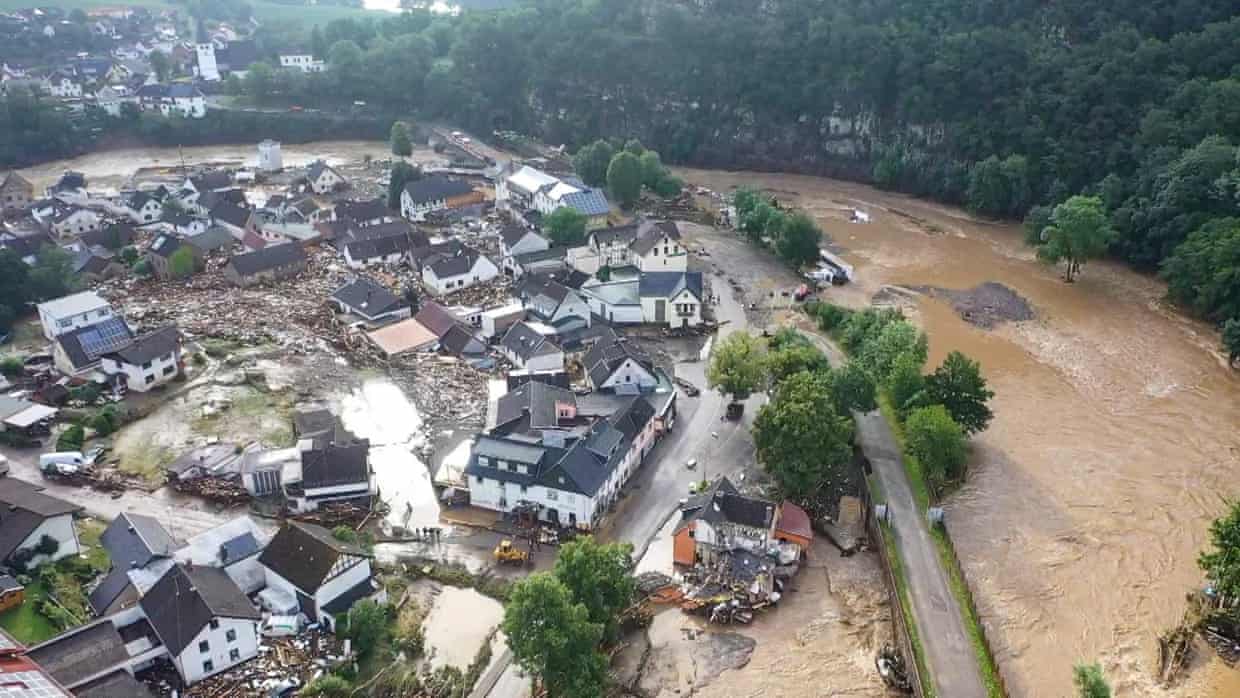
Five years after the disaster, DW reported continuing construction in the Ahr Valley: a new retaining wall, redesigned bridges and efforts to restore floodplains. The aim was to reduce vulnerability rather than simply reproduce everything that had stood beside the river before.
The report also described proposed upstream retention works, with planning and construction potentially extending over decades. Those were future measures, not completed protection. The distinction explains how a place can look increasingly rebuilt while the work intended to make it safer remains unfinished.
14 July 2026
In Theux, a restored building marked a local return
Across the border in Belgium, a commemoration in Theux included the inauguration of the restored Maison Lebrun. Vedia reported the event the following day, describing the listed building behind the town hall as fully restored after flood damage.
The report said the building would accommodate municipal offices and meeting spaces. The inauguration was a completed local milestone; the planned uses were a next stage. Neither the building nor one town’s progress could stand for every affected household or the whole of Wallonia.
15 July 2026
Wallonia’s five-year report described a new phase of work
Regional broadcaster Qu4tre reported in June that roughly 50 urgent interventions were complete, while 14 larger projects were under way or planned for 2026. In its 15 July account, the regional public service described the move towards major riverbank works, alongside changes to crisis coordination and planning.
It pointed to a risk-coordination centre and a regional crisis-management plan, as well as work intended to slow and store water. These were the administration’s descriptions of its programme, not an independent guarantee of how it would perform in another extreme event. In both countries, the aftermath had become a combination of completed repairs, continuing construction and future prevention.
Qu4tre · Vesdre reconstruction programme · 25 June 2026 · Service public de Wallonie · five-year progress report · 15 July 2026
22 October 2026
At Lake Warfaaz, another recovery project received funding
The work continued beyond the five-year commemorations. On 22 October, the Walloon government approved a €1.52 million grant for the tourism part of the Lake Warfaaz redevelopment in Spa. The lake and its damaged surroundings had lost much of their visitor appeal after the 2021 floods.
The approved funding covers 60% of eligible tourism costs, including plans for a continuous walk around the lake and accessible paths. It is part of a larger redevelopment with hydraulic works intended to improve flood protection. The grant is not the total cost of that wider project, evidence that the money has all been paid, or confirmation that the lake has reopened.
Regional broadcaster Vedia reported the decision and said a precise works timetable had not yet been announced. The contrast with a running German railway or an inaugurated Belgian building is useful: recovery contains finished milestones, work in progress and newly funded plans at the same time.
Vedia · Warfaaz tourism funding and pending timetable · 22 October 2026
The evidence
Sources for this update
- 01BBK · Cell Broadcast operational launch · 23 February 2023
- 02Deutsche Bahn · Ahr railway reopening announcement · 12 December 2025
- 03Ahrtal Tourism · restored railway service, checked 14 November 2026
- 04DW · Ahr Valley rebuilding and protection · 14 July 2026
- 05Qu4tre · Vesdre reconstruction programme · 25 June 2026
- 06Vedia · restored Maison Lebrun in Theux · 15 July 2026
- 07Service public de Wallonie · five-year progress report · 15 July 2026
- 08Vedia · Warfaaz tourism funding and pending timetable · 22 October 2026
Where the story stands
Recovery and prevention run on different clocks.
A reopened railway or a restored building can be a completed job without being the end of a disaster’s aftermath. The evidence shows specific repairs, new warning arrangements and continuing work in both countries. It does not establish that all households recovered, every rebuilding project finished or future extreme floods became harmless. Those broader outcomes remain open.