


8–24 January 2022
The telescope unfolded and reached its observing orbit
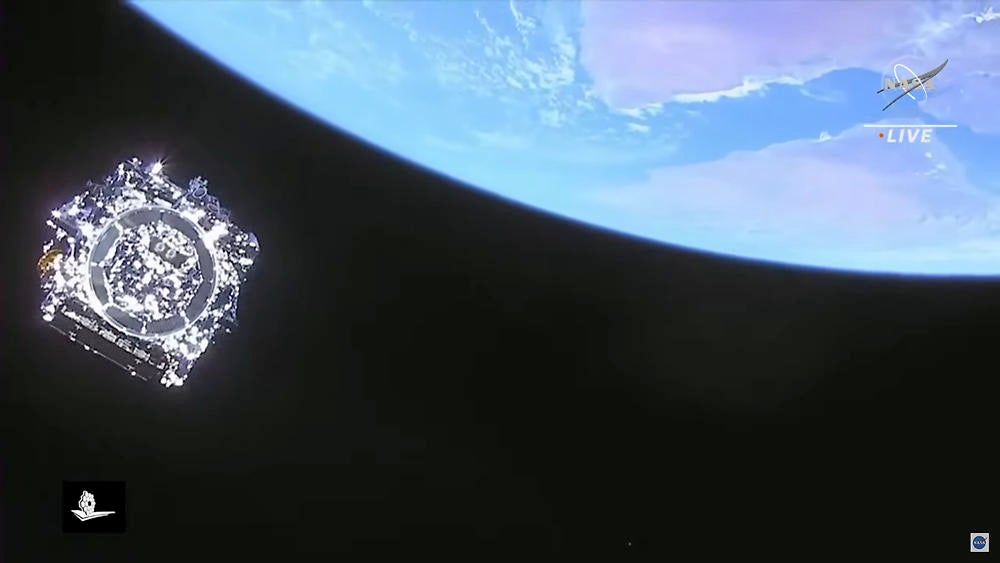
Getting off the launch pad was only the beginning. Webb still had to unfold its large sunshield and segmented mirror before months of alignment and calibration. The main deployment was completed on 8 January 2022, and Webb reached its orbit around the second Sun–Earth Lagrange point on 24 January. That cleared the first major hurdle: the observatory had to become a working instrument before its promised discoveries could begin.
Deployment completed · 8 January 2022 · Arrival at L2 · 24 January 2022
12 July 2022
The first images became the start of science operations
The first full science release included distant galaxies, a stellar nursery, a dying star, interacting galaxies and a planetary atmosphere. These targets demonstrated the instruments’ different capabilities. The release also marked the start of science operations, rather than the completion of the mission. Webb’s measurements of WASP-96b showed water and evidence of clouds and haze in the atmosphere of a hot gas giant. Water in that setting was a chemical observation, not evidence that the planet supported life.
22 November 2022
Planetary chemistry became measurable in greater detail
For WASP-39b, researchers combined several instrument modes to build a richer atmospheric profile. They identified sulfur dioxide and explained it using models of chemistry driven by the host star’s energetic light. The accompanying research connected a measured spectral feature to a plausible physical process. This delivered a concrete part of the launch promise to investigate planets around other stars. It also shows the distinction between studying atmospheric chemistry and establishing habitability: WASP-39b is a hot gas giant, and this finding was not a discovery of life.
Atmospheric chemistry · 22 November 2022 · Sulfur dioxide research paper
28 January 2026 · NASA account
A galaxy reached back to 280 million years after the Big Bang
Webb spectroscopy confirmed a redshift of 14.44 for the bright galaxy MoM-z14. The research places it at a time about 280 million years after the Big Bang. This is a measured example of the early-galaxy science promised at launch, not merely an attractive deep-space photograph. The researchers found a population of bright early galaxies more abundant than pre-Webb models expected. Understanding that difference remains research in progress; the observation does not establish that every question about the first galaxies has been answered.
Early galaxy confirmation · 28 January 2026 · MoM-z14 research paper
8 October 2026
Webb identified the host of an exceptionally distant radio burst
The radio signal FRB 20240304B was detected by South Africa’s MeerKAT telescope on 4 March 2024. Webb subsequently found its host galaxy and measured a redshift of 2.148, placing the event when the universe was about three billion years old. The October 2026 account accompanies publication in Science; an earlier preprint was already public in August 2025. Webb did not detect the radio burst itself. Its contribution was the infrared imaging and spectroscopy needed to identify and measure the faint host. That small, actively star-forming galaxy offers a clue to the burst’s origin, rather than conclusive proof of the mechanism.
Latest radio-burst host findings · 8 October 2026 · Radio-burst paper · earlier August 2025 preprint · Paris Observatory account · 8 October 2026
The evidence
Sources for this update
- 01Mission deployment timeline
- 02First science release · 12 July 2022
- 03Atmospheric chemistry · 22 November 2022
- 04Sulfur dioxide research paper
- 05Early galaxy confirmation · 28 January 2026
- 06MoM-z14 research paper
- 07Latest radio-burst host findings · 8 October 2026
- 08Radio-burst paper · earlier August 2025 preprint
- 09Paris Observatory account · 8 October 2026
- 10Deployment completed · 8 January 2022
- 11Arrival at L2 · 24 January 2022
Where the story stands
Ending FoundThe launch story has its answer.
The launch carried a promise to look further into the early universe and examine planets around other stars. Deployment and commissioning turned that promise into a working observatory; the atmospheric measurements and early-galaxy findings showed what it could do. That brings this launch-to-results account to its conclusion. Webb’s mission continues. Questions about bright early galaxies and the origin of the radio burst remain subjects of further research, rather than unfinished launch milestones.