

Menu
DisastersInternational · 2021

What happened to La Palma after the volcano?

The lava stopped in 2021. Five years later, the follow-up is about temporary homes, neighbourhoods reopening and the places still waiting.

THE ORIGINAL STORY2021-09-20
Sam Jones in Madrid and agencies
20 September 2021
Canary Islands: 5,000 evacuated as La Palma volcano eruptions continue
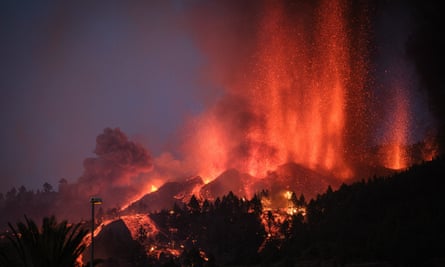
The eruption in El Paso in the Guardian’s original September 2021 reportAnadolu Agency / Getty Images · The Guardian original report
Read the original report

The first reports counted evacuations. Recovery needed a longer timeline.

These reports cover the eruption’s first two days. The Guardian page was first published on 19 September and updated on 20 September; the displayed headline and source card use that updated report. Its photograph shows the eruption in El Paso. The later question is what happened after the immediate emergency.

The eruption ended. Rebuilding homes and restoring access are still unfolding.

AI-generated symbolic house, construction blocks and cooled lava rock; not a photograph of an actual La Palma home

Public spaces have reopened and further properties have been cleared for use. But the October 2026 access decision still describes restrictions, while the latest independent housing account reviewed here reports unfinished reconstruction. An authorisation is not the same as a household moving home.

The story, in dates

Event dates
Scroll back through the story
  1. “Canary Islands: 5,000 evacuated as La Palma volcano eruptions continue”

    The Guardian · Original headline

  2. The lava came first. Displacement followed.

    The eruption began near Cabeza de Vaca, in El Paso, after a period of seismic activity and ground deformation. Spain’s National Geographic Institute dates its start to 19 September 2021.

  3. Canary Islands: 5,000 evacuated as La Palma volcano eruptions continue

    The Guardian · original early report, updated 20 September

  4. The eruptive phase ended after 85 days

    The National Geographic Institute records the end of the eruptive episode on 13 December, after 85 days and eight hours. The date marks the end of that episode, rather than the day authorities publicly declared it over.

  5. The official ending came on Christmas Day

    Authorities announced the eruption’s end on 25 December. La Palma’s official account describes the confirmation after the long eruptive episode; the scientific record dates the end of activity earlier in the month.

  6. One public space reopened, as recovery advanced in pieces

    In August 2026, Spain’s reconstruction commissioner welcomed the reopening of Playa Chica in Puerto Naos. The ministry described it as another step in recovering areas affected by volcanic gases.

  7. Reconstruction support was still being legislated five years later

    Spain’s Official State Gazette published fresh measures on 9 September 2026. They extended an island-specific income-tax measure into the 2026 tax year and enabled the Canary Islands to direct €100 million toward assistance connected to the eruption.

  8. Temporary homes were still occupied at the fifth anniversary

    RTVE’s five-year report found 60 modular and wooden emergency dwellings still occupied. It described households unable to complete reconstruction or find an affordable alternative, alongside residents still affected by gas-related access restrictions.

  9. Another home was cleared, with restrictions still in place elsewhere

    The island council authorised one more dwelling in Puerto Naos on 27 October after carbon-dioxide measurements met its criteria. It reported 1,253 authorised premises across Puerto Naos and La Bombilla, with documentation signed for 1,086.

The lava came first. Displacement followed.

The eruption began near Cabeza de Vaca, in El Paso, after a period of seismic activity and ground deformation. Spain’s National Geographic Institute dates its start to 19 September 2021.

The original newspaper and television reports captured the immediate emergency: evacuations, threatened homes and a landscape changing in front of residents. Those were early counts, not a final damage assessment. The question that outlasted the eruption was how people would rebuild their lives.

Spain’s National Geographic Institute · eruption chronology

The eruptive phase ended after 85 days

The National Geographic Institute records the end of the eruptive episode on 13 December, after 85 days and eight hours. The date marks the end of that episode, rather than the day authorities publicly declared it over.

The distinction matters because “the volcano stopped” can sound like the end of the emergency. It did not repair the buildings and roads in the lava’s path, or by itself establish that every affected area could be occupied again.

Spain’s National Geographic Institute · eruption chronology · La Palma official tourism authority · end-of-eruption announcement

The official ending came on Christmas Day

Authorities announced the eruption’s end on 25 December. La Palma’s official account describes the confirmation after the long eruptive episode; the scientific record dates the end of activity earlier in the month.

This answered one part of the remembered headline. The eruption had ended. The recovery would need its own record: access to neighbourhoods, usable homes and the repair of places people depended on. Later official monitoring continued, rather than disappearing with the announcement.

Spain’s National Geographic Institute · eruption chronology · La Palma official tourism authority · end-of-eruption announcement

One public space reopened, as recovery advanced in pieces

In August 2026, Spain’s reconstruction commissioner welcomed the reopening of Playa Chica in Puerto Naos. The ministry described it as another step in recovering areas affected by volcanic gases.

A beach reopening is a tangible change for a neighbourhood and its visitors. It is still a decision about a particular space, not a declaration that all homes and streets are unrestricted. The ministry connected the reopening to technical work and cooperation between public bodies.

Spanish reconstruction commissioner · Playa Chica reopening · 7 August 2026

Reconstruction support was still being legislated five years later

Spain’s Official State Gazette published fresh measures on 9 September 2026. They extended an island-specific income-tax measure into the 2026 tax year and enabled the Canary Islands to direct €100 million toward assistance connected to the eruption.

The legislation itself describes continuing social and economic difficulties. Authorising a funding route does not establish that every payment has been made or every project finished. It shows that recovery remained an active public-policy task, years after the lava stopped.

Official State Gazette · reconstruction measures · 9 September 2026

Temporary homes were still occupied at the fifth anniversary

RTVE’s five-year report found 60 modular and wooden emergency dwellings still occupied. It described households unable to complete reconstruction or find an affordable alternative, alongside residents still affected by gas-related access restrictions.

The broadcaster also reported construction of 53 public homes, with completion then expected in December. That was a stated plan, not evidence the homes had already been delivered. Its account makes the human distinction clear: an island can regain services while some households remain in temporary accommodation.

RTVE · five years of incomplete reconstruction · 19 September 2026

Another home was cleared, with restrictions still in place elsewhere

The island council authorised one more dwelling in Puerto Naos on 27 October after carbon-dioxide measurements met its criteria. It reported 1,253 authorised premises across Puerto Naos and La Bombilla, with documentation signed for 1,086.

These are premises and permission records, not a count of people physically rehoused. The council said checks continued at properties awaiting authorisation and in areas still subject to restrictions.

Cabildo de La Palma · individual return authorisations · 27 October 2026 · La Palma Ahora / elDiario.es · reports the council decision · 27 October 2026

Sources for this update

  1. 01Spain’s National Geographic Institute · eruption chronology
  2. 02La Palma official tourism authority · end-of-eruption announcement
  3. 03Spanish reconstruction commissioner · Playa Chica reopening · 7 August 2026
  4. 04Official State Gazette · reconstruction measures · 9 September 2026
  5. 05RTVE · five years of incomplete reconstruction · 19 September 2026
  6. 06Cabildo de La Palma · individual return authorisations · 27 October 2026
  7. 07La Palma Ahora / elDiario.es · reports the council decision · 27 October 2026

The lava stopped. The recovery has its own timeline.

The remaining milestones concern stable housing and access to properties that still face restrictions. The dated records show real progress alongside unfinished recovery. They do not provide a single verified completion date for everyone affected.

Still wondering about another story?

Tell us what you remember. We'll follow up...

Ask Then What? →
No exact headline needed.
Request a follow-up →
We’ll use your email only to handle this request and let you know if it’s published. No newsletter signup.Add a name to be credited publicly if your question becomes a story. Leave it blank for a “Requested update” stamp.Your email stays private. Requests are reviewed; publication is not guaranteed. We use your details only for this request, as explained in our privacy notice.
Next: your email. No newsletter signup.