


5 December 2022
A tiny fuel target crossed a scientific threshold
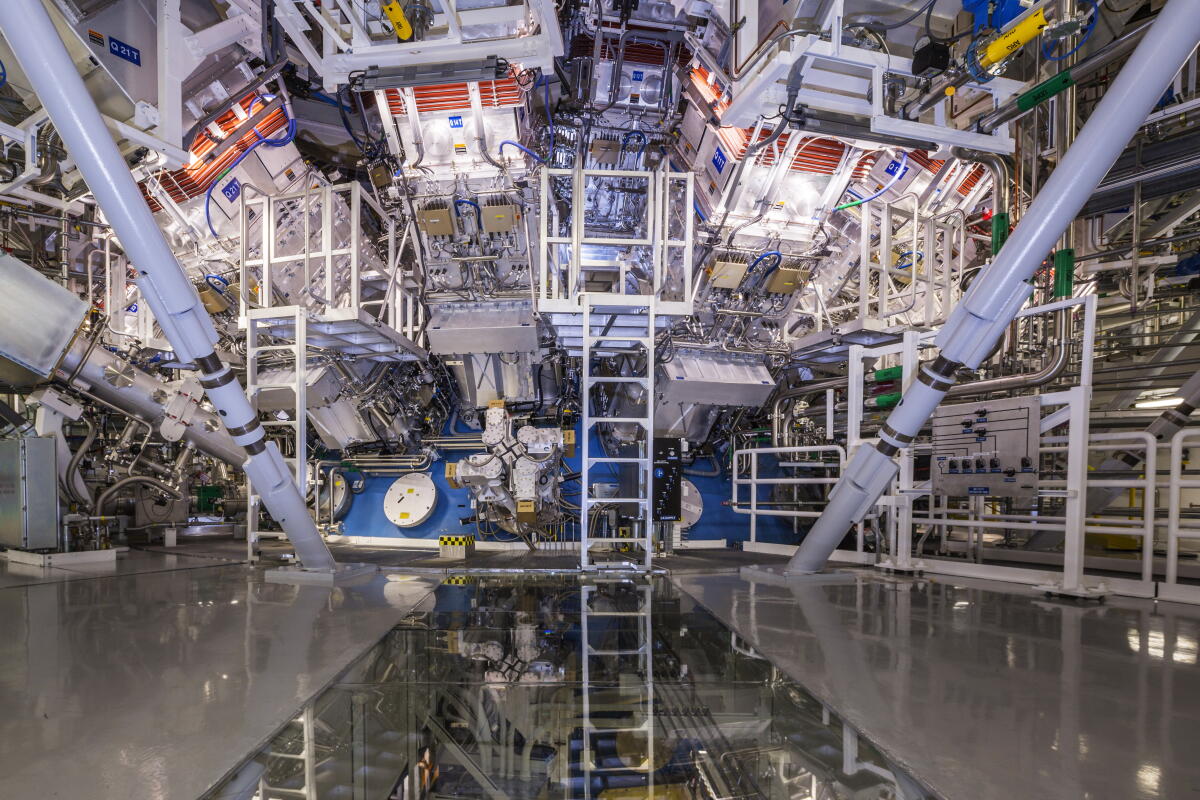
The experiment happened eight days before the announcement. At California’s National Ignition Facility, laser light drove a fuel capsule inward until hydrogen nuclei fused, releasing energy. LLNL reported 3.15 megajoules of fusion energy from 2.05 megajoules of laser energy delivered to the target.
That comparison is the key to the headline. It measures the light arriving at the target against the fusion energy coming out. It does not count all the electricity needed to run the laser system, and it does not describe electricity delivered to homes. The experiment established a scientific milestone; a working power station was a much larger question.
LLNL · original ignition announcement · December 2022 · LLNL Science & Technology Review · fusion power engineering · July/August 2025
30 July 2023
They did it again
One successful shot left an obvious follow-up question: could the team repeat it? LLNL’s experiment record lists another ignition on 30 July 2023, producing 3.88 megajoules from 2.05 megajoules of laser energy on target.
The result moved the story beyond a single historic event. It still did not establish the rapid, economical operation a power plant would need. Repeating a scientific experiment on separate occasions and running equipment continuously for customers are different tests.
LLNL · dated ignition experiment record · checked 2 November 2026 · LLNL Science & Technology Review · fusion power engineering · July/August 2025
7 April 2025
The yield rose to more than four times the laser energy on target
The April 2025 shot produced 8.6 megajoules from 2.08 megajoules delivered by the lasers, according to LLNL. Its reported target gain was 4.13. The Government Accountability Office’s September 2025 review also records an approximately 8.6-megajoule maximum as of May that year.
This was an improvement in the experiment’s energy yield, not evidence that the whole facility had become a net electricity producer. ASME’s later engineering account placed the result within the wider effort to turn fusion research into usable power. The word “gain” still needs its boundary: here, it refers to energy at the target.
LLNL · target design behind the record · 15 April 2026 · US Government Accountability Office · September 2025 facility review · American Society of Mechanical Engineers · Fusion Time · August 2025
15 April 2026
A small change inside the target helped explain the bigger result
LLNL’s later account traced an important part of the record to the fuel capsule. Engineers gradually varied a small tungsten addition within its synthetic-diamond layers, rather than changing the concentration in abrupt steps. The laboratory says this helped reduce unwanted mixing of capsule material into the fuel.
This is the less cinematic part of the follow-up: progress depended on manufacturing and modelling tiny targets, alongside the laser and diagnostic systems. The explanation connects the record to particular engineering work. It is the laboratory’s account of its own research, rather than an independent demonstration of a commercial reactor.
June 2026
The power-plant question still had an engineering programme attached
The Department of Energy’s June 2026 roadmap sets out work needed to move fusion toward commercial power. It identifies gaps involving materials, fuel cycles, components and the systems needed to turn a fusion machine into an operating plant.
LLNL’s own engineering review makes the distinction explicit: NIF is an experimental facility, not a power plant. Future inertial-fusion plants would need efficient drivers, inexpensive targets delivered repeatedly and equipment able to handle the heat and radiation. A roadmap describes a programme of work; it does not certify that these problems have been solved. Its disclaimer also says it does not commit the department to particular funding levels.
US Department of Energy · Fusion Science and Technology Roadmap · June 2026 · LLNL Science & Technology Review · fusion power engineering · July/August 2025
20 June 2026
An eleventh ignition, with the commercial question still open
In the latest dated entry on LLNL’s ignition record checked for this account, the laboratory reports an eleventh ignition on 20 June 2026. It gives a yield of 7.9 megajoules, with measurement uncertainty of plus or minus 0.4 megajoules, and a target gain of about 3.8.
That is below the April 2025 record, but it adds another successful ignition. The sequence is a collection of experiments, not a promise that every shot will beat the last. The follow-up to 2022 is substantial: ignition has been repeated, yields have improved and researchers have explained changes that helped. Producing dependable, affordable electricity remains a different milestone.
LLNL · dated ignition experiment record · checked 2 November 2026 · US Department of Energy · Fusion Science and Technology Roadmap · June 2026
The evidence
Sources for this update
- 01LLNL · original ignition announcement · December 2022
- 02LLNL · dated ignition experiment record · checked 2 November 2026
- 03LLNL · target design behind the record · 15 April 2026
- 04US Government Accountability Office · September 2025 facility review
- 05US Department of Energy · Fusion Science and Technology Roadmap · June 2026
- 06LLNL Science & Technology Review · fusion power engineering · July/August 2025
- 07American Society of Mechanical Engineers · Fusion Time · August 2025
Where the story stands
Repeated ignition. A different test for practical power.
The remaining question is whether the science and engineering can be combined in a practical electricity-generating plant. The dated NIF experiment record and June 2026 roadmap describe progress and outstanding work, not a guaranteed delivery date. Sources checked 2 November 2026.