

29 February 2024
A week of work, then silence
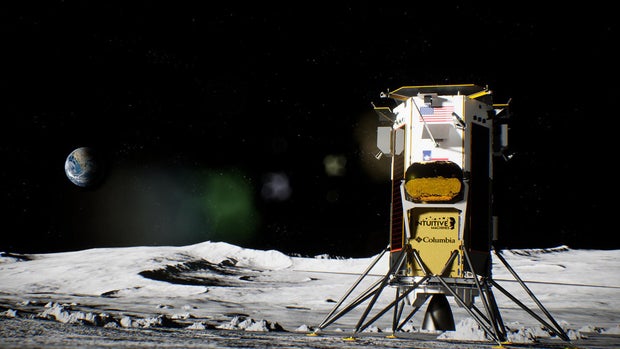
Odysseus had come to rest at an angle, restricting power and communications. It nevertheless operated for a week. On 29 February, controllers put its computer and power systems into standby as the lunar night arrived.
Space.com reported that the team left open the possibility of hearing from it after sunlight returned. That possibility mattered: going quiet was a milestone, but it was not yet confirmation that the spacecraft would never operate again. A difficult landing and an unanswered wake-up question were different parts of the story.
Space.com · shutdown · 29 February 2024 · NASA · surface science account · 1 March 2024 · Science News · mission end, updated 26 March 2024
1 March 2024
Useful data did not mean every goal was met
NASA’s post-mission account said each of its six instruments had achieved some level of its objectives. The agency reported more than 500 megabytes of science, technology and spacecraft data ready for analysis — a combined total, not a measure of science data alone.
The limitations were concrete. The plume-study camera captured images in transit and after landing, but did not obtain the intended pictures of rocket exhaust interacting with the ground during touchdown. Other instruments returned navigation and radio observations. The mission had delivered a record worth studying, without delivering every planned observation.
23 March 2024
The hoped-for second shift never came
Intuitive Machines said it began listening for a wake-up signal on 20 March. On 23 March, the company concluded that Odysseus’s power system would not make another call home. Space.com and Science News reported that conclusion.
The company’s announcement closed the operational uncertainty left by February’s shutdown. It did not erase the data already received, and it did not establish whether later landers would fare better. Odysseus’s own working life was over; the work on Earth could continue.
Science News · mission end, updated 26 March 2024 · Space.com · company’s 23 March wake-up conclusion
12 March 2025
The small radio record became a scientific result
A year later, Joshua Hibbard and colleagues posted an analysis of ROLSES-1, the radio instrument aboard Odysseus. Across the journey and surface operations, it had collected roughly two hours of data. The authors found evidence consistent with human-made shortwave transmissions reaching it from Earth.
The March 2025 author manuscript also explored the faint galactic background, with limited data and substantial noise complicating the result. A later IEEE Spectrum account described the recovery of useful radio results. The experiment left researchers with a constrained measurement and techniques for analysing lunar observations, even though the instrument’s time on the Moon had ended.
Hibbard and colleagues · ROLSES-1 author manuscript, March 2025 · arXiv · manuscript submission history · IEEE Spectrum · later independent account of the radio results
The evidence
Sources for this update
- 01NASA · surface science account · 1 March 2024
- 02Space.com · shutdown · 29 February 2024
- 03Science News · mission end, updated 26 March 2024
- 04Space.com · company’s 23 March wake-up conclusion
- 05Hibbard and colleagues · ROLSES-1 author manuscript, March 2025
- 06arXiv · manuscript submission history
- 07IEEE Spectrum · later independent account of the radio results
Where the story stands
Ending FoundA finished mission, with something left to study.
The operational story has an ending: Odysseus did not return to work. Its scientific aftermath is more nuanced than either a flawless success or a write-off. Some objectives were missed, useful data reached Earth, and later analysis found value in a small surviving record. Future lunar telescopes are separate missions, rather than an unfinished wait for this lander to wake.