



25 January 2024
The landing worked, but the final position caused trouble
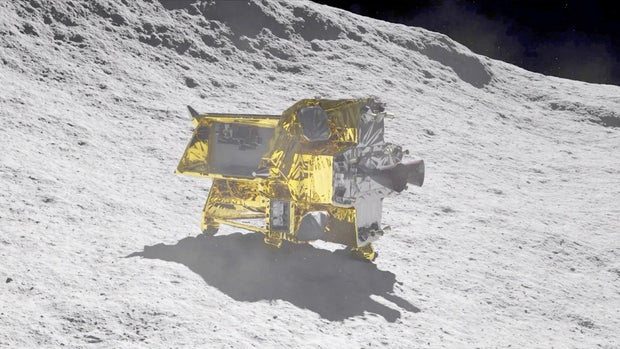
JAXA’s first detailed assessment confirmed a pinpoint landing. SLIM had reached the surface near its target, but a late propulsion problem left it in an unintended position, with its solar cells unable to provide the power it initially needed.
This separated two questions that had become tangled on landing night. The navigation demonstration could succeed even though the spacecraft was not sitting as planned. Images from the small robot released before touchdown helped show what had happened on the surface.
28 January 2024
Sunlight gave the lander another chance
The angle of sunlight changed, and contact returned. AP reported JAXA’s confirmation the next day: the lander could again transmit observations rather than remaining a battery-powered mission that had lasted only hours.
For a short time, the problem had been where the sunlight fell, not a complete loss of the spacecraft. With power restored, the team could resume observations of nearby rocks. This was the substantial answer missing from the first-night headlines.
28 April 2024
It survived more than its design had promised
The final project briefing recorded operations across three lunar nights, with the last successful contact on 28–29 April 2024. The repeated returns allowed engineers to learn about performance through extreme changes between lunar day and night.
The last contact did not immediately become an official end date. Teams continued trying to re-establish communication during later opportunities. Keeping those stages separate explains why a spacecraft could stop answering in April while the formal mission remained open intoAugust.
23 August 2024
JAXA ended lunar operations
After the later contact attempts failed, JAXA ended SLIM’s surface operations on 23 August 2024 and announced the decision on 26 August. The lander was not waiting for another routine wake-up attempt.
That gives the operational story a firm endpoint. It had demonstrated its landing approach, returned observations and exceeded expectations for survival. The mission’s end did not erase the propulsion problem or turn the unplanned landing attitude into an intended result.
JAXA: operations ended,26 August 2024 (Japanese) · JAXA final briefing,26 December 2024 (English PDF) · JAXA archive: completed SLIM mission
26 December 2024
The final review confirmed what had been achieved
JAXA’s project review assessed the landing demonstration and the observations returned before operations ended. It treated the mission as completed while identifying research that could continue after the project itself.
This later review provides the confirmation beyond the August shutdown. Future lunar programmes may reuse lessons or techniques, but SLIM does not have to wait for every later mission to succeed before its own story can be concluded.
18 June 2026
A later paper showed what its tiny companion had done
JAXA announced published results from LEV-2, the palm-sized rover carried with SLIM. The Science Robotics paper had appeared on 10 June; the agency’s 18 June announcement released additional imagery and explained evidence of autonomous movement, photography and communication.
That is a later result from the original mission, not a new landing or a revival of the main spacecraft. It shows why the story continued to produce knowledge after the radio fell silent. The first-night power crisis ended up being one chapter in a completed mission with a documented scientific and engineering legacy.
JAXA: LEV-2 results published,18 June 2026 · Science Robotics: SORA-Q study,10 June 2026 · Doshisha University: lunar demonstration results,18 June 2026
The evidence
Sources for this update
- 01JAXA: landing outcome,25 January 2024
- 02AP: power restored,29 January 2024
- 03JAXA: operations ended,26 August 2024 (Japanese)
- 04JAXA final briefing,26 December 2024 (English PDF)
- 05JAXA: LEV-2 results published,18 June 2026
- 06Science Robotics: SORA-Q study,10 June 2026
- 07JAXA archive: completed SLIM mission
- 08Doshisha University: lunar demonstration results,18 June 2026
Where the story stands
Ending FoundThe mission is over. Its results live on.
The power failure that threatened to end SLIM’s first night did not have the last word. The lander recovered, returned observations and survived three lunar nights before its working life ended in August 2024. JAXA’s later review confirmed that completed mission, and the June 2026 rover findings show its data still producing results. The difficult landing remains part of the story; continuing research does not mean the spacecraft is still awaiting its ending.