


8 March 2025
The storm weakened, but the damage did not disappear
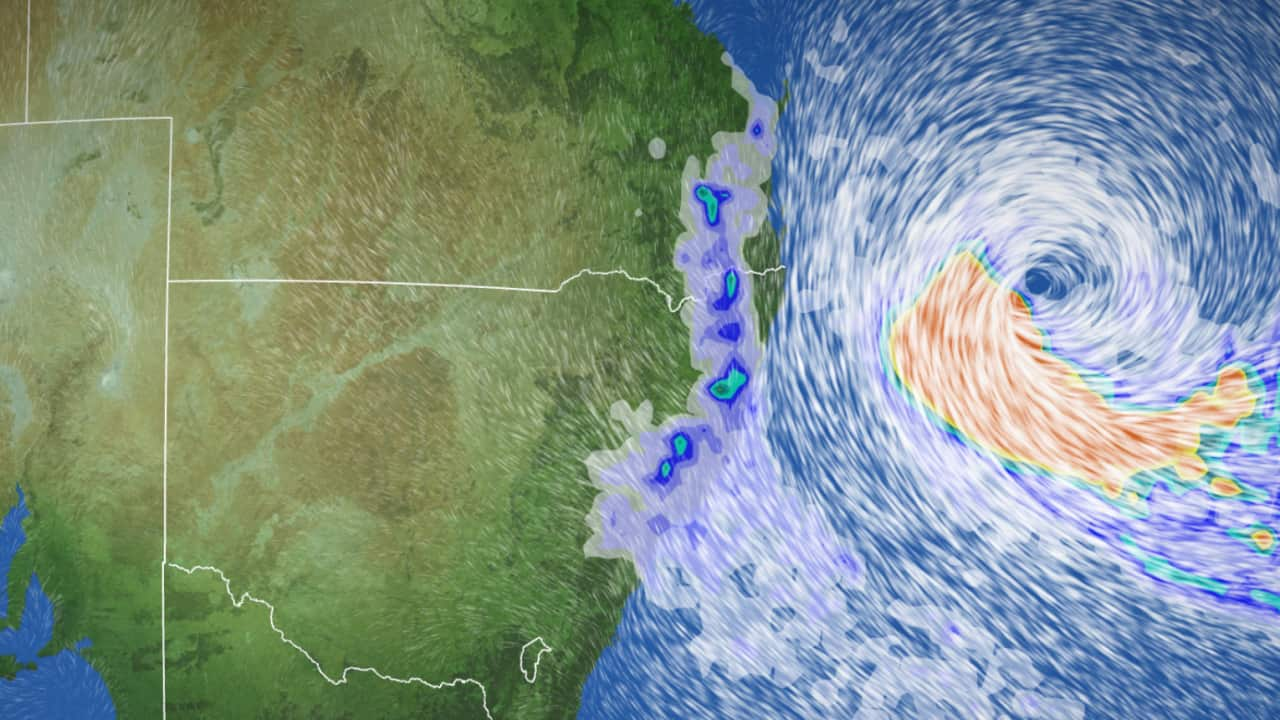
The Bureau of Meteorology’s retrospective records Alfred crossing Moreton Island early on 8 March, weakening before its later mainland crossing. Its account describes damaging winds, flooding and coastal erosion across southeast Queensland and northeast New South Wales, with more than 500,000 customers losing power. The approaching-storm headlines captured a forecast. What happened next has to be judged against the actual damage and recovery, rather than whether an earlier forecast arrival time or intensity held.
Storm track and impacts · Bureau of Meteorology retrospective
18 February 2026
Beach restoration had funding, with work still to deliver
The Queensland Reconstruction Authority described A$57 million for coastline rehabilitation, supporting 20 initiatives including sand reshaping and vegetation planting. It formed part of a broader A$74 million environmental recovery program. This establishes funding and intended work, rather than completion of every beach repair. Erosion recovery is one strand of the aftermath: restoring coastal protection and habitat is different from finalising a household’s insurance claim.
Coastal recovery funding · Queensland Reconstruction Authority · 18 February 2026
8 March 2026 · report published
One insurer had finalised most claims; some complex cases remained
Suncorp’s anniversary release said it had finalised more than 93% of 34,151 Alfred claims as at 4 March 2026. It said some complex claims remained open. This is the insurer’s account of its own customers, not a measure covering every affected household or every insurer. A finalised claim and a fully rebuilt community are also different things. The figures show substantial progress in that claims pool while leaving a clear remaining group to follow.
One-year claims position · Suncorp · 8 March 2026 · pages 1–2
30 March 2026 · report published
Recovery grants had reached producers and businesses
NEMA’s one-year account reported that, by January 2026, more than A$6.95 million had been paid in primary-producer recovery grants and more than A$2.03 million to small businesses and not-for-profits. These are identified payments, rather than a total of every recovery measure or a promise that all announced funding had been spent. The agency acknowledged that recovery was still continuing for some communities. Assistance paid, claims closed and physical reconstruction each answer a different part of the recovery question.
19 June 2026 · project update
Road reconstruction was underway, with a major repair still ahead
Queensland’s transport department reported reconstruction underway on Gold Coast–Springbrook Road, following a May start. Alfred had added 70 damage sites to a repair program already dealing with earlier storms. The department’s June update said work on a major 30-metre upslope slip at Neranwood was expected to begin in late 2026. That is a target, not evidence of completion. This road is a specific example of continuing infrastructure repair, not a claim that the whole affected region has the same timetable.
Road reconstruction status · Queensland Transport and Main Roads · updated 19 June 2026
The evidence
Sources for this update
- 01Storm track and impacts · Bureau of Meteorology retrospective
- 02Coastal recovery funding · Queensland Reconstruction Authority · 18 February 2026
- 03One-year claims position · Suncorp · 8 March 2026 · pages 1–2
- 04Recovery grants paid · NEMA · 30 March 2026
- 05Road reconstruction status · Queensland Transport and Main Roads · updated 19 June 2026
Where the story stands
The story continues when the evidence does.
The next updates will follow repairs actually delivered, remaining insurance claims and any revised reconstruction timetable. The late-2026 Neranwood works target remains a target in the June record. These dated records show parts of the recovery; they do not establish a region-wide completion date.