


Menu
PoliticsInternational · 2025

What happened after the India–Pakistan fighting?

A ceasefire ended the four-day escalation. Later confrontations showed how much remained unsettled.

THE ORIGINAL STORY2025-05-07
Shubhajit Roy and Amrita Nayak Dutta
7 May 2025
‘Justice is served’: India launches ‘Operation Sindoor,’ strikes on Pakistan, headquarters of LeT and JeM
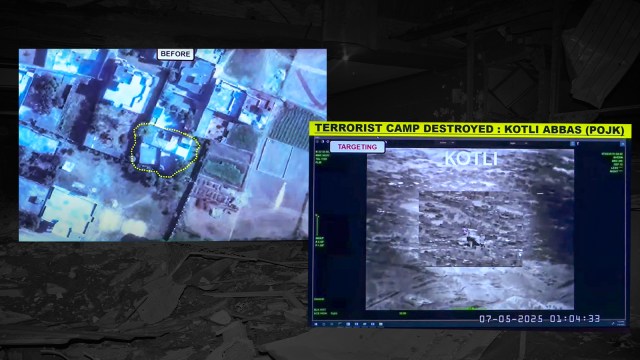
Imagery shown at a New Delhi military briefing in the original Indian Express report; labels represent the military presentationPTI · briefing imagery via The Indian Express
Read the original report

The strikes became the headline. The claims needed attribution.

India launched Operation Sindoor on 7 May 2025 after the attack near Pahalgam that killed 26 people. India blamed Pakistan, which denied involvement. These Indian television and newspaper headlines captured the opening strikes. Their descriptions of targets and success reflected the Indian account, not findings adopted by this follow-up. The selected PTI photograph shows imagery presented at a New Delhi briefing; its on-screen labels are military claims, not independent verification of the targets or damage.

The fighting stopped. The dispute did not.

AI-generated symbolic closed gate and padlock in photographic halftone; not a real India–Pakistan border location

The May 2025 ceasefire stopped four days of fighting, but it did not settle India and Pakistan’s wider disputes. A year later, relations remained strained. A naval collision in September and a disputed border shooting in October brought fresh diplomatic protests. Pakistan and India gave conflicting accounts of the shooting; neither is treated here as an independently established finding. The military pause was an important outcome, not a completed peace settlement.

The story, in dates

Event dates
Scroll back through the story
  1. “‘Justice is served’: India launches ‘Operation Sindoor,’ strikes on Pakistan, headquarters of LeT and JeM”

    The Indian Express · Original headline

  2. Four days of fighting ended in a ceasefire

    India and Pakistan agreed to stop the fighting on 10 May, after exchanges involving missiles, drones and artillery. The UN welcomed the ceasefire as a step towards easing tensions, rather than a settlement of the countries’ longstanding disputes.

  3. The anniversary brought an uneasy calm

    A year later, CNA’s reporting described a truce overshadowed by mistrust. Relations remained strained, with diplomatic ties downgraded. The two sides also differed over how the pause had been achieved: Pakistan endorsed the US mediation account, while India pointed to talks between the militaries.

  4. A collision at sea brought fresh protests

    Indian and Pakistani naval vessels collided on 15 September. The next day, each government summoned the other’s senior diplomat. Reuters reported that both blamed the other for the encounter and that no major damage had been reported.

  5. Two deaths at the border reopened the argument

    After a 2 October border shooting, Pakistan said Indian border guards had killed two unarmed civilians and demanded an investigation. India rejected Pakistan’s account, saying the people involved had entered Indian territory illegally and ignored warnings. Reuters reported the opposing statements as both countries summoned diplomats on 3 October.

Four days of fighting ended in a ceasefire

India and Pakistan agreed to stop the fighting on 10 May, after exchanges involving missiles, drones and artillery. The UN welcomed the ceasefire as a step towards easing tensions, rather than a settlement of the countries’ longstanding disputes.

The difference mattered. The immediate military escalation could end without resolving the attack that preceded it or the rivalry around Kashmir. A stop to the fighting answered the most urgent question; it did not provide a shared account of how the crisis had begun.

United Nations · ceasefire account · 15 May 2025 · CNA · one-year aftermath · 7 May 2026

The anniversary brought an uneasy calm

A year later, CNA’s reporting described a truce overshadowed by mistrust. Relations remained strained, with diplomatic ties downgraded. The two sides also differed over how the pause had been achieved: Pakistan endorsed the US mediation account, while India pointed to talks between the militaries.

That disagreement was part of the aftermath, not evidence that no ceasefire existed. The useful question had shifted from whether the four-day battle would stop to whether the pause could become a more durable relationship. CNA’s account gave no reason to treat those as the same achievement.

CNA · one-year aftermath · 7 May 2026

Two deaths at the border reopened the argument

After a 2 October border shooting, Pakistan said Indian border guards had killed two unarmed civilians and demanded an investigation. India rejected Pakistan’s account, saying the people involved had entered Indian territory illegally and ignored warnings. Reuters reported the opposing statements as both countries summoned diplomats on 3 October.

The Indian Express also carried the opposing official accounts. These reports do not establish which government’s explanation was correct. Nor does the incident, by itself, establish that the May-style military campaign had resumed. It does show why stopping that campaign was not the end of the wider security dispute.

Reuters via ThePrint · disputed border shooting · 3 October 2026 · The Indian Express · opposing border accounts · 3 October 2026

Sources for this update

  1. 01United Nations · ceasefire account · 15 May 2025
  2. 02CNA · one-year aftermath · 7 May 2026
  3. 03Reuters via MarketScreener · naval collision · 16 September 2026
  4. 04Reuters via ThePrint · disputed border shooting · 3 October 2026
  5. 05The Indian Express · opposing border accounts · 3 October 2026
  6. 06The Tribune · Indian policy statement · 28 October 2026

A pause in fighting still needs a future.

This remains an open story about relations after the May escalation. The ceasefire was a real change; later incidents were real sources of renewed tension. At an October briefing reported by The Tribune, India said its Pakistan policy had not changed. An invitation to a multilateral forum did not, by itself, establish that bilateral relations were returning to normal. A lasting settlement and practical normalisation remain different tests from simply announcing a truce.

Still wondering about another story?

Tell us what you remember. We'll follow up...

Ask Then What? →
No exact headline needed.
Request a follow-up →
We’ll use your email only to handle this request and let you know if it’s published. No newsletter signup.Add a name to be credited publicly if your question becomes a story. Leave it blank for a “Requested update” stamp.Your email stays private. Requests are reviewed; publication is not guaranteed. We use your details only for this request, as explained in our privacy notice.
Next: your email. No newsletter signup.