



6 April 2026
Around the Moon, without a landing
The crew passed around the Moon, making observations and recording what they could see. The route carried them beyond Earth orbit and back towards home.
It matters what sort of mission this was. Artemis II did not take astronauts down to the surface or put them into an extended lunar orbit. It was a crewed flight test around the Moon, with observations made from Orion along the way. The landing belongs to a later stage of the programme.
NASA · Safe return, 10 April · NASA Science · Postflight research, 5 June
10 April 2026
The journey ends in the Pacific
Nine days after leaving Florida, the four astronauts were back on Earth. Orion splashed down off California on 10 April, completing the crewed flight around the Moon.
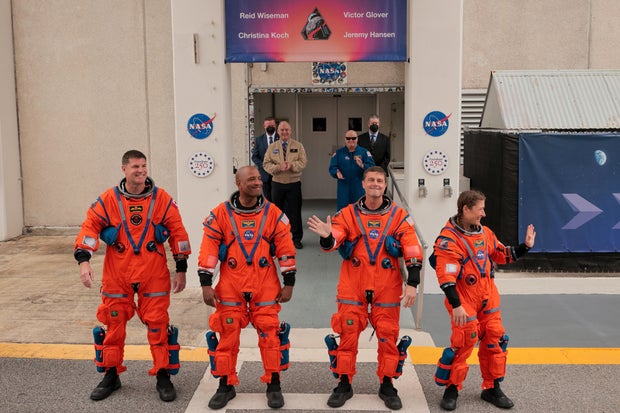
The purpose was to try the rocket and spacecraft with people aboard before later lunar missions. Wiseman, Glover, Koch and Hansen had flown around the Moon, not landed on it. Returning safely answered the immediate question raised by the launch: could this crew make the journey and come home?
That was the end of their flight. It was also the beginning of work that could only happen once the spacecraft, its records and its passengers were back on Earth.
5 June 2026 · research report
The astronauts were also research participants
In the days after landing, the crew helped researchers examine what the journey had done to their bodies and performance. NASA’s June account described tests of movement, thinking and tasks relevant to working after a spaceflight.
These were practical questions for future exploration. After reaching another world, how quickly could a crew move safely, handle equipment or complete a demanding task? Postflight measurements let researchers compare performance before and after the journey. The June date is when NASA described this work; it does not mean every test happened that day.
The agency said the initial health-study data collection ended 45 days after splashdown, while lifetime medical monitoring would continue. Health records are not simply being posted with the Moon photographs: the account describes processing and anonymising research information before access through a separate life-sciences archive.
9 June 2026
Another crew takes the next flight
NASA named Randy Bresnik, Frank Rubio, Andre Douglas and European Space Agency astronaut Luca Parmitano for Artemis III. Their planned 2027 mission is a rehearsal in Earth orbit for equipment and operations needed on later journeys.
Orion is the spacecraft that carries the astronauts. A lunar lander has a different job: taking people from lunar orbit to the surface and back. Before relying on those vehicles far from Earth, the programme plans to practise how they meet and dock.
Under the published plan, Artemis III will work with test versions of landers being developed by SpaceX and Blue Origin. Artemis IV is targeted to take astronauts to the lunar surface in 2028. These are plans, not flights that have already happened, and the dates depend on readiness.
NASA · Next crew announced, 9 June · NASA · Artemis III docking demonstration explained, 15 July
6 July 2026 · departure announced
For Hansen, the next destination is a different career
The Canadian Space Agency announced that Hansen would leave active astronaut duties, with his new chapter beginning in September. He would pursue other professional opportunities while continuing as a Royal Canadian Air Force reservist.
His departure did not end Canada’s involvement in exploration. It marked a change in his own role after the flight. The announcement does not establish that he has another space mission assigned.
9 September 2026 · NASA announcement
Wiseman and Glover step away from active flying
NASA announced that Wiseman and Glover were moving to emeritus status during September. Instead of remaining on the active flight roster, they could volunteer their experience in training, mentoring and specialist advice.
Glover’s next job was already taking shape. Cal Poly announced a full-time leadership role, effective 1 September, working on strategy, partnerships and related university initiatives. The university appointment and NASA’s emeritus announcement describe separate parts of that transition.
The sources checked do not establish a comparable new employer for Wiseman. His confirmed change is the emeritus role; the account does not fill that gap with speculation.
NASA · Wiseman and Glover’s new status, 9 September · Cal Poly · Glover’s university role, 9 September
7 October 2026
The Moon observations become a public research resource
On 7 October, NASA opened a lunar science dataset of more than 800 gigabytes to the scientific community and public. It includes more than 11,000 full-resolution images and video, 8.5 hours of spoken scientific observations, and annotated images.
The numbers describe the lunar science release, not every engineering measurement or private medical record from the flight. The material is archived in the Planetary Data System, alongside reports that explain how it was gathered and how to use it.
There is already something concrete to investigate. NASA’s preliminary science account describes five faint flashes reported by the crew, which the science team assessed as impacts after considering other possible explanations. The observations could help researchers understand small impacts and the risks they pose to future equipment on the Moon.
Researchers can now examine the images, recordings and notes together and compare them with observations from robotic spacecraft. Releasing the records enables that work; it does not mean every interpretation has been settled or every future scientific result is known.
NASA · Lunar science data released, 7 October · NASA Science · Preliminary lunar science report · Planetary Data System · Artemis II data archive
13 October 2026
Koch’s next role keeps her at NASA, on the ground
NASA announced that Koch would become acting deputy chief engineer on 1 November. The role involves engineering oversight and mission readiness across the agency.
With the appointment she will move into management astronaut status and will no longer be eligible for future flight assignments. As of this account’s 16 October research date, that start date remains ahead.
Taken together, the announcements give the crew’s postflight story an unexpected shape: the four people who flew around the Moon are moving into different roles, while a different crew prepares for the next Artemis flight. Their experience remains part of the programme without another flight being promised to them.
NASA · Koch appointment, 13 October · NASA · Wiseman and Glover’s new status, 9 September · Canadian Space Agency · Hansen’s departure, 6 July
14 October 2026 · briefing announced
What happens next — and what has not happened yet
NASA has scheduled a programme update for 23 October, covering the next Artemis flight and progress towards a lunar landing. That is the next announced checkpoint for the plans described here.
For readers following the sequence, the next steps are:
- 23 October 2026: a scheduled NASA programme briefing; its contents are not yet known.
- 2027: the planned Artemis III Earth-orbit demonstration, including docking tests.
- 2028: the targeted Artemis IV lunar landing. This is a goal, not a guaranteed date.
NASA · Programme briefing announced, 14 October · NASA · Next crew announced, 9 June
15 October 2026 · engineering assessment
The spacecraft’s data are helping test the next flight
The data story is not confined to Moon photographs. NASA reported on 15 October that its postflight engineering assessment confirmed Orion’s heat shield had performed as expected. Engineers were checking what happened to the spacecraft during the return through Earth’s atmosphere, when the shield protected the people inside.
For Artemis II, NASA shortened part of the reentry trajectory after investigating heat-shield damage on the uncrewed Artemis I mission. The agency says the change substantially reduced cracking and loss of charred material. That is a reported result from this flight, rather than a promise about a future one.
Work continues. Engineers are comparing laser scans taken before and after flight to measure how much material wore away, and extracting samples for further tests. Those engineering records serve a different purpose from the public lunar science dataset: they help refine spacecraft design and preparation for later missions. A successful assessment is progress towards the next flight, not confirmation that it has launched.
The evidence
Sources for this update
- 01NASA · The launch, 1 April
- 02NASA · Safe return, 10 April
- 03NASA Science · Postflight research, 5 June
- 04NASA · Next crew announced, 9 June
- 05Canadian Space Agency · Hansen’s departure, 6 July
- 06NASA · Wiseman and Glover’s new status, 9 September
- 07NASA · Lunar science data released, 7 October
- 08NASA · Koch appointment, 13 October
- 09NASA Science · Preliminary lunar science report
- 10Planetary Data System · Artemis II data archive
- 11Cal Poly · Glover’s university role, 9 September
- 12NASA · Programme briefing announced, 14 October
- 13NASA · Artemis III docking demonstration explained, 15 July
- 14NASA · Postflight heat-shield analysis · 15 October 2026
Where the story stands
Still UnfoldingThe flight is finished. The follow-through is still unfolding.
Liss asked about the people, the data and the next mission. The crew’s career announcements answer the first part, with Koch’s new role still due to begin in November. The public lunar dataset and the heat-shield assessment show two different uses of the flight’s evidence. Further scientific interpretation, engineering analysis and readiness for the next flight remain unfinished. NASA’s scheduled 23 October briefing is the next announced checkpoint; the 2027 demonstration and 2028 landing remain plans.